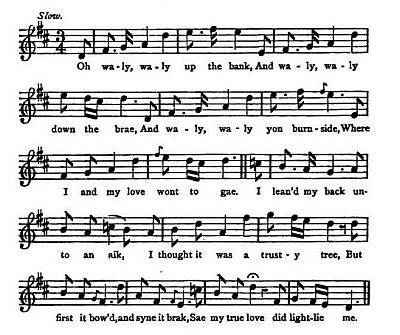
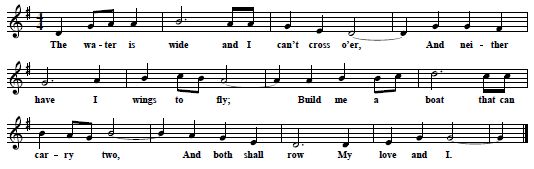
The water is wide and I can't cross over Here is one version of the tune:
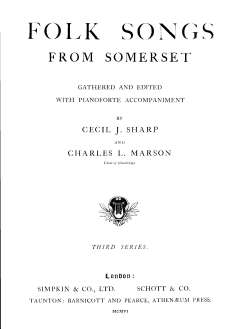
But that was not correct. The original version of "The Water is Wide" can be found in Folk Songs From Somerset. Third Series by Cecil Sharp and Charles Marson. This collection was published in London by Simpkin & Co. in 1906 (available at IMSLP, here No. LXVI, p. 32/33). Here it was still called "Waly, Waly". In the Notes on the Songs (p.76) a "Mrs. Cox, of High Ham" is mentioned as the source for both the words and the tune. Sharp also remarked that he had "noted this song in Somerset five times - tunes and words varying considerably" but that "our Somerset words have so much affinity with the well-known Scottish ballad 'Waly, Waly' that we are publishing them under the same title". These notes are somewhat misleading. They seem to suggest that Sharp had collected the song in exactly this form. But in fact he had created it anew by collating bits and pieces from different field-recordings. What he regarded as "Folk"-versions of that old Scottish ballad were in fact mutilated fragments of two different broadside-songs. Already in 1954 J. W. Allen - in a seminal article in the Journal of the English Folk Dance and Song Society (pp.161-171) - has compared the published version with the original field-recorded variants in the manuscripts and was able to show convincingly how Sharp had put together this song. He even identified one of the two broadside ballads in question. The following text is an attempt at outlining the history and prehistory of "The Water Is Wide". Mr. Allen has laid the groundwork for any further examination of this problem with his article but I try to discuss it in a broader context. A couple of questions come to mind: why and how did the song collectors like Cecil Sharp edit their field-recorded texts for publication? What was their notion of authenticity? How did the anonymous writers of broadside ballads produce their texts? What did broadside writers and folklorists have in common? Why were so-called "floating verses" so important for the production of both broadside ballads and "Folk songs"? In fact this is a very fascinating story that shows how mutilated relics of ancient popular songs were reinterpreted as remainders of "old folk songs" and then – restored to honor and patched together to a new "old" song - started a second, even more successful life.
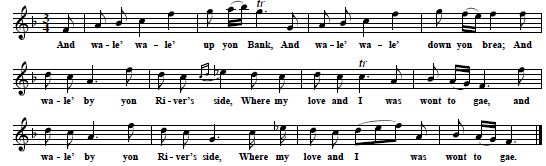
II. But at first it is necessary to go back to 1720s and have a look at this old Scottish ballad "Oh Waly, Waly, Gin Love Be Bonny". This song was first printed in 1725/6 in two groundbreaking publications. A version with a tune and four verses - including variant forms of two we know from the modern "The Water Is Wide" - can be found in William Thomson's Orpheus Caledonius, or a Collection of the best Scotch Songs. Here it was called "Wale' Wale' up yon Bank" (p. 34, available at Early Books of Scottish Songs, NLS) . :
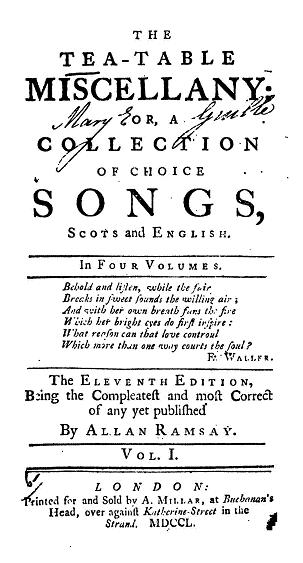
And wale' wale' up yon Bank, Thomson was a Scottish singer who had moved to London. There he obviously had great success and was "favoured at court on account of his Scots songs" (Farmer 1962, p. I). His Orpheus Caledonius - the very first collection of Scottish songs - was dedicated to the Princess of Wales. This book was published on January 1st, 1726 (see the advert in the Daily Post, December 31, 1725, GDN Z2000268762, BBCN). Another version - this time only a text without a tune - was included by Allan Ramsay in the second volume of his immensely influential Tea-Table Miscellany. The exact publication date is not clear. The first volume had come out in 1724 (ESTC N045927). In the catalogue of the National Library of Scotland the second is dated as from 1726 (see Copac; see also Martin 1931, p. 97)). If this is correct it would mean that it was published after Thomson's collection. In fact Ramsay's version is bit different from Thomson's. The verse with the "cockle shells" is missing. Instead we get seven additional quatrains (here pp. 179-180 from the 10th edition, Dublin 1734): O, waly waly upon the bank In 1733 William Thomson published a second expanded edition of his Orpheus Caledonius. Here he not only simplified the bass of his first version of this song but he also changed he title to "Waly, Waly" and added six of the additional verses from Ramsay's text on two extra pages (No. 34, available at the Internet Archive):
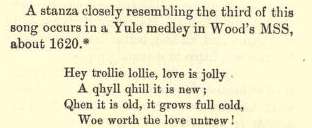
Ramsay has marked "Oh, Waly, Waly" with a "Z" as an "old song", but we don't know how old it was when he published it. Nor do we know if and how much Ramsay and Thomson have edited their texts. But at least one verse was already known a hundred years earlier. A variant of the second can be found in a manuscript from the 1620s (see Child IV, No. 204, p. 93):
This particular lines were also used as the fourth verse in a Cantus for three voices that was published in Aberdeen in 1666 in the second edition of Thomas Davidson's Cantus, songs and fancies, to three, four, or five parts (ESTC R213597, available at EEBO, image 48):
Of course this doesn't mean that "Oh Waly, Waly" already existed at that time. It is far more likely that the anonymous creator of this song simply borrowed an older verse. Interestingly five of the seven additional stanzas from Ramsay's text can also be found in other songs. One was part of the ballad "The Seamans Leave Taken Of His Sweetest Margery" (first printed ca. 1650, ESTC R227870, available at EEBO; see also Pepys 4.158, 1681-84, at EBBA): If I had wist before I had kist, But "Oh Waly, Waly" also shares four verses with "Arthur's Seat Shall Be My Bed, or: Love in Despair". This "New Song much in Request" was apparently published circa 1701 (available at NLS: The Word On The Street; see also Child, p. 93 and p. 105, see also Allen, p. 167): [...] The exact relationship between the two songs is not clear. Did the author of "Arthur's Seat" borrow these stanzas from "Oh Waly, Waly". Was it the other way round? But this would mean that "Oh Waly,Waly" was not that old because it then must have been written after "Arthur's Seat". Of course it is also possible that the writers of both pieces have borrowed these verses from another undocumented older song. Not at least it cannot be excluded that they were only later - sometime between 1701 and 1726 - added to the Scottish ballad. But I assume it can't have been Ramsay himself. In this case he would have marked "Oh Waly,Waly" not with a "Z" as an old song but with a "Q, old songs with additions". Some verses from "Oh Waly, Waly" can be found in a couple of variants of "Jamie Douglas" (see Child No. 204). This ballad was first printed in a fragmentary version in in 1776 in the second edition of David Herd's Ancient and Modern Scottish Songs (Vol. 1, p. 144, here in the reprint published in 1869; see also Motherwell 1827, p. 395, Chambers 1829, p. 133-140). Motherwell (p. 407) claims that this ballad was "frequently sung to the same tune as 'Waly, Waly, Up The Bank'" but the one he has included (p. 421; also Bronson III, No. 204.5, p. 260) is quite different. Lord Douglas and Lady Erskine were divorced in 1681 so the ballad of course must have been written after that date. According to most experts "Oh Waly, Waly" apparently predates "Jamie Douglas" (see Bronson III, p.258; Friedman 1956, p. 101, Allen 1954, p. 166).
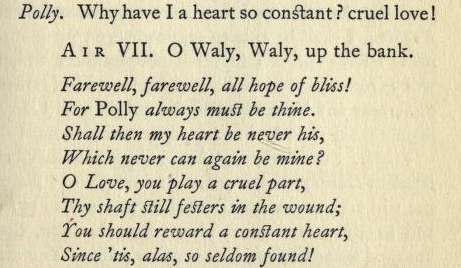
Altho' so fondly Men profess The tune can also be found in the collections of both major Scottish composers of that time (see Olson, Incomplete Index). James Oswald included it both in his Curious Collection of Scots Tunes (1740) and in the Caledonian Pocket Companion (Vol. 1, 1743, p. 5, available at the Internet Archive). William McGibbon published his arrangement in the Collection of Scots Tunes (ca. 1742; here Book III, p. 87 in Robert Bremner's new edition, ca. 1768, available at IMSLP). But just like John Gay they both didn't use the version from Thomson's Orpheus Caledonius but instead one that suited Ramsay's 8-line double-stanzas:
Allan Ramsay's text remained available throughout the 18th century, not only because the Tea-table Miscellany were reprinted regularly: 1793 saw the 18th edition. It was also included in many songsters, for example The Lark (1740, 1742), The Merry Companion (1742), The Charmer (1752, 1765), The Scots Blackbird (1766, 1768), The Blackbird (1771, 1783, p. 91, at Google Books) and The Diary Maid: Or, Vocal Miscellany (1784; all available at ECCO) and in chapbooks like this one:
But the text of "Oh Waly, Waly" also found a place in the most important antiquarian collections of that time: Thomas Percy's Reliques of Ancient English Poetry (1765, here pp. 144-6 in the 3rd ed., 1775) and David Herd's Ancient And Modern Scottish Songs (1769, pp. 196-7, ESTC T078132, available at ECCO; here from the 2nd ed. 1776, Vol. 1, pp. 81-2). Towards the end of the century the song was published in all major collections of Scottish songs. It was available in sophisticated arrangements, for example in William Napier's Selection of the most Favourite Scots Songs Chiefly Stafforal, Adapted for the Harpsichord, with an Accompaniment for a Violin By Eminent Masters (London, 1790, No. 60, ESTC T219204, available at ECCO) and in the first volume of George Thomson's Select Collection of Original Scottish Airs (1793, No. 19, ESTC T186186, available at ECCO). Thomson had hired Austrian composer Ignaz Pleyel as the arranger and also added a completely unnecessary new English text with the title "Hard Is The Fate Of Him Who Loves". More simple arrangements with only the bass were published by James Johnson in his Scots Musical Museum (Vol. 2, 1788, No. 158, p. 166 & Vol. 5, 1797, No. 446, p. 458) and David Sime in his Edinburgh Musical Miscellany (Vol. 2, Edinburgh 1793, p. 328, all available at the Internet Archive):
Not at least antiquarian Joseph Ritson included the tune and the text in his Scotish Songs (Vol. 1, here pp. 235-6 in the reprint Glasgow 1869). He refrained from using a bass part and claimed that "the Scottish songs are purely melody, which is not infrequently injured by the basses which have been set to them by strangers: the only kind of harmony known to the original composers consisting perhaps in the unisonant drone of the bagpipe" (p. 7):
At this time "Oh Waly, Waly" was established as an "old Scottish ballad". It remained in print during the next century and was still regularly performed and published. We again can find the song in different surroundings. Ramsay's text was for example included on these two Long song sheets printed some time between 1813 and 1838:
A quick search at Copac shows that it was also regularly published in new professional musical arrangements, for example in:
And of course it found a place in scholarly publications like The Garland of Scotia. A Musical Wreath of Scotish Song by John Turnball and Patrick Buchan (Glasgow 1841, p. 54), George F. Graham's The Songs of Scotland (1848, Vol. 1, pp. 100-1) and Edward F. Rimbault's Musical Illustrations of Bishop Percy's Reliques (1850, pp.102 & 35-6). Graham noted that the "air is beautiful and pathetic" but complained about the quality of earlier arrangements: "The simplicity of the original has been spoiled by several flourishes introduced into it by tasteless and ignorant collectors. M'Gibbon, Oswald, Bremner, and others, have much to answer for in the matter of pseudo-embellishment of our finest old airs. We have removed from 'Waly, Waly' the absurd trappings hung about its neck by these men". The song was also well known in North America. The melody was used for example for teaching the violin (Howe's New Violin Without A Master, 1847, p. 111). Swedish Opera singer Christina Nilsson performed it her concerts and her version was published in 1870 in The Authorized Edition of [her] Songs as sung by her in America (available at the Lester S. Levy Collection of Sheet Music), but with a new tune written by one Jacques Blumenthal. Ralph Waldo Emerson included the text in his poetry anthology Parnassus (1875, p. 382). Later Carl Sandburg introduced a minimalist version in his American Songbag (1927, p. 16). The tune is completely different and for some reason the verse with the "cockle shells" has returned: When cockle shells turn silver bells, "Oh Waly, Waly" survived into the 20th century and was also recorded during the Folk Revival era, for example by Hermes Nye (Early English Ballads From The Percy And Child Collections, 1957, Folkways FW 02305), by Peggy Seeger & Ewan MacColl (Two-Way Trip, 1961, Folkways FW 08755) and by John Jacob Niles whose eccentric version was first released in 1953 on American Folk Love Songs to Dulcimer Accompaniment (Boone-Tolliver BTR-22, 10" LP) and then in 1959 on An Evening With John Jacob Niles (Tradition TLP1036, available at amazon.co.uk).
III.Allan Ramsay's version of "Oh Waly, Waly" had a long and honorable history and it is still performed today. "The Water Is Wide" is a much younger song that was - as already noted – first published under the very same title by Cecil Sharp and Charles Marson in 1906 in Folk Songs From Somerset. Third Series (No. LXVI, pp. 32/33). Their song included variants of two verses known from the old Scottish ballad but otherwise the rest of the text and the tune were completely different.
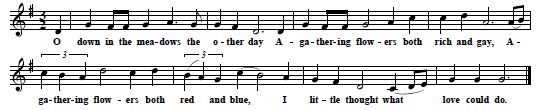
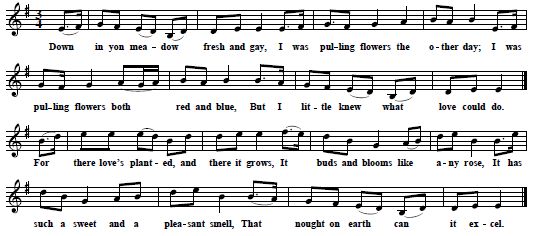
The water is wide l cannot get o'er The Folk Songs From Somerset were no academic collection. Sharp wanted to revitalize these songs that he saw as "our national heritage, or some salvage of it" (Introduction, p. ix). The song was reissued two years later by another publisher, Novello & Co. , as sheet music in the series "School Songs". Interestingly there was no copyright notice in the Folk Songs From Somerset. But Novello & Co. registered the song in 1908 (renewed in 1936). Their copyright was acknowledged by Pete Seeger and Oak Publications when they published "The Water Is Wide" in 1960 in the songbook American Favorite Ballads. A second variant of this song with some minor changes in the text and two additional verses was included in Cecil Sharp's One Hundred English Folk Songs (No. 39, pp. 90), a book published by Ditson in New York and Boston in 1916. The notes (p. xxx) are more or less the same as in the Somerset collection but here Sharp refrained from naming his informant: The water is wide, I cannot get o'er "O Waly, Waly" was compiled by Cecil Sharp from parts of three different field recordings he had made in Somerset between 1904 and 1906. One was by Mrs. Caroline Cox (1905, Karpeles 35A, p. 171; Sharp Ms.: CJS2/9/604 (text), CJS2/10/535 (tune) at The Full English Digital Archive; also in Allen, p. 163). and he took the tune and four of the five verses - one of them known from the Scottish "Oh Waly, Waly" - from this variant:
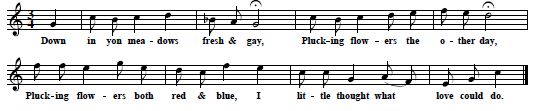
Down in the meadows the other day, The second one was from James Thomas (1906, Karpeles 35B, p. 172; Sharp Ms.: CJS2/9/989 (text), CJS2/10/923 (tune) at The Full English Digital Archive). Sharp used two of his four verses for the extended text published in 1916:
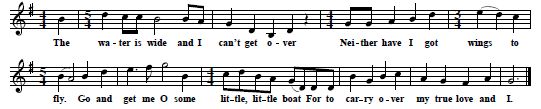
O down in the meadows the other day A fragment supplied by Mrs. Elizabeth Mogg (1904, Karpeles, No. 35C, p. 173; Sharp Ms.: CJS2/9/504 (text), CJS2/10/374 (tune) at The Full English Digital Archive) was the source for the first and the last verse. This is clearly a relic of a different song although Sharp apparently also regarded it as related to the old Scottish "Oh Waly, Waly" because it included a variant form of one of its stanzas:
The water is wide and I can't get over Two years later Mrs. Mogg sang another version with two different verses (Karpeles, p. 173, Sharp Ms.: CJS2/9/1027 (text), CJS2/10/984 (tune) at The Full English Digital Archive; also quoted by Allen, p. 165): The water is wide and I can't get over
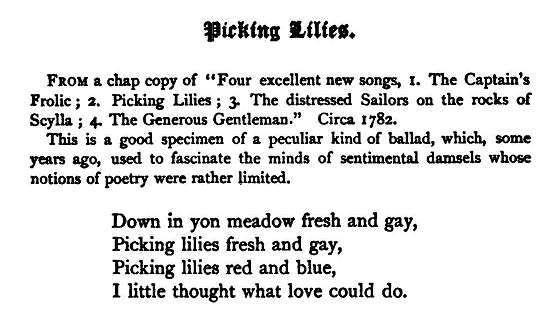
IV.The pieces Sharp collected from Caroline Cox and James Thomas were not remainders of "Waly, Waly" but fragments of an old broadside ballad that was known under the titles "The Unfortunate Swain", "Picking Lilies" and "The Maid's Complaint". Mrs. Cox used five of the original nine verses - the first, then the seventh, the sixth, the fifth and the last - while Mr. Thomas only recalled four of them: the first, the second, the sixth and the third: Down in yon Meadow fresh and gay, This seems to be the earliest of the available extant texts. It was published on a broadside where it was only called "A New Love Song". This song-sheet has no imprint but in the English Short Title Catalogue "1750?" is suggested as the possible year of publication and John White in Newcastle as the printer:
It was somehow courageous to publish this piece as a "new song". In fact it was mostly a compilation of verses from earlier broadsides: at least five of the nine were borrowed from other songs. One ("I set my foot against an oak...") was cribbed from "Oh Waly, Waly". Two can be found in Martin Parker's "The Distressed Virgin" (first printed 1633, ESTC S112529, available at EEBO; see also Douce Ballads 1(59a), between 1663 and 1674, at BBO; Pepys 3.313, ca. 1678-80, at EBBA): I put my finger in the bush, If Roses be such prickling flowers Amazingly the anonymous author also resorted to songs that also share verses with Allan Ramsay's version of "Oh Waly, Waly" although he used not the same but others. Apparently the relationship between these texts was well known at that time. One was taken from "The Seamans Leave Taken of his Sweetest Margery" (see Pepys 4.158, 1681-1684, at EBBA; first printed ca. 1650, see ESTC R227870) but only in a rather mutilated form. In the original text the rhymes worked much better: I have seven ships upon the sea, Another one may have been taken from "Arthur's Seat Shall Be My Bed, or: Love in Despair" (ca. 1701, see NLS: The Word On The Street), although it looked a little different there: Should I be bound that may go free? The compiler of this "new song" was surely well acquainted with old popular songs but his abilities as a poet left something to be desired. The rhyme scheme is inconsistent. In some verses it's aabb, in others abab or abcb and in the last one the first two lines do not rhyme with each other ("end/best"). Unfortunately we don't know anything else about this song. Was it written by a more or less professional broadside poet for the printer who then threw this piece on the market in hope that the people would pick it up and? Or was it a transcription of a popular song written and performed by a professional musician? Nor do we know the tune originally used for this text. None was indicated on the song-sheet and it was later never published with a melody in a songbook. Nonetheless it seems that the song became very popular. At least it was regularly republished during the next decades and well into the 19th century. The text remained more or less stable, there were only minor changes as well as occasional attempts at repairing some of its flaws (see the pdf-file with all available printed variants). Around 1770 a slightly edited text was included in a small collection of song-texts:
This was the first time this song was called "The Unfortunate Swain". The first verse looks a little bit different and in the last a correct rhyme-word was inserted into the first line: Down in a Meadow both fair and gay, Two broadsides without imprint have also survived. In the English Short Title Catalogue 1780 and 1790 are given as possible dates of publication:
Here the roses are introduced into the first verse: Down in a meadow fair and gay After the turn of the century "The Unfortunate Swain" was published in Scotland in at least four different chapbooks. They are all listed in the catalogue of Scottish chapbooks on the website of the University of Glasgow:
This song was also published with other titles. It can be found as "Picking Lilies" in some chapbooks from the
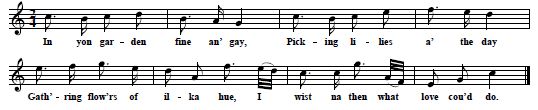
Four copies of another edition called "The Maid's Complaint" - also with eight instead of nine verses - can be found among the Madden Ballads (8-5377; 9-5914 & 6132; 10-7033). One of them (9-6132) was published by Alice Swindells in Manchester and another one by Theophilus Bloomer in Birmingham. According to the British British Book Trade Index Mrs. Swindells was active as a printer between 1790 and 1828 while Mr. Bloomer was in this business between 1817 and 1827. One may assume that they both have published this song at around the same time. This strongly suggests that these two editions as well as the two other without an imprint were thrown on the market in the late '10s or during the '20s. By all accounts "The Unfortunate Swain" remained popular for considerable time. It was published regularly – though sometimes with different titles - for at least 70 years. Already in 1803 a fragmentary version consisting of only three verses but including a tune was published by James Johnson in the sixth volume of his Scots Musical Museum. William Stenhouse in his notes to the 1839 edition of this collection reports that "the words and music of this were taken down from the singing of Mr. Charles Johnson", James Johnson's father, who claimed to have learned this piece "in his infancy, and he was then informed that it was very ancient". If this information is correct it would mean that this song had already existed in Scotland sometime before it was printed for the very first time around 1750 ("In Yon Garden", No. 563, p. 582 & notes, pp. 487-8, in the edition published in 1839):
In yon garden fine an' gay, Another version of this song can be found in the Thomas Hepple Manuscript. In 1855 the Society of Antiquaries of Newcastle upon Tyne "appointed a committee 'to protect and preserve the ancient melodies of Northumberland'". Two years later the Duke of Northumberland offered prizes for the two best collections of "ancient Northumbrian music". Thomas Hepple, a "local singer" from Kirkwhelpington, sent in his manuscript of 24 songs, in his own words "some old ballads I have had off by ear since boyhood" (Lloyd, Foreword to Bruce/Stokoe, pp. vi & xi; Rutherford 1964, pp. 270-2). His text – with six of the nine original verses - is very close to the printed versions and one may assume that he or his source had learned the song from a broadside or chapbook (online available at FARNE). The tune is clearly related to the one published in the Scots Musical Museum:
Down in a meadow fresh & gay In 1867 a reader sent in four verses to the magazine Notes And Queries (3rd Ser., V William Christie's Traditional Ballad Airs, Vol. 1 (1876, p. 226) includes a song called "The Prickly Rose" that he had collated from two Scottish variants of "The Unfortunate Swain". One was "sent to the Editor [Christie] in 1850 by a native of Buchan", the other from an "old woman in Buckie [...] She died in the year 1866 at the age of nearly 80 years. Her father [...] had the sobriquet 'Meesic' [...] indicating his fame as a ballad-singer" (dto. p. 42). The text is very similar to the printed versions and one may assume that he had a broadside or a chapbook with that song at hand. Otherwise he obviously refrained from major revisions. On the other hand it is impossible to say how much he has edited the tunes:
Down in yon meadow fresh and gay, Sabine Baring-Gould, parson and squire in a parish in West Devon who started collecting the old songs in the late '80s, included a version with a piano arrangement called "Deep In Love" in his Songs And Ballads Of The West (1891, pp. 184/5, notes p. xxxviii). For the revised edition published in 1905 the song was rechristened to "A Ship Came Sailing" (No. 86, pp. 176-7). In the informative notes three informants are credited:
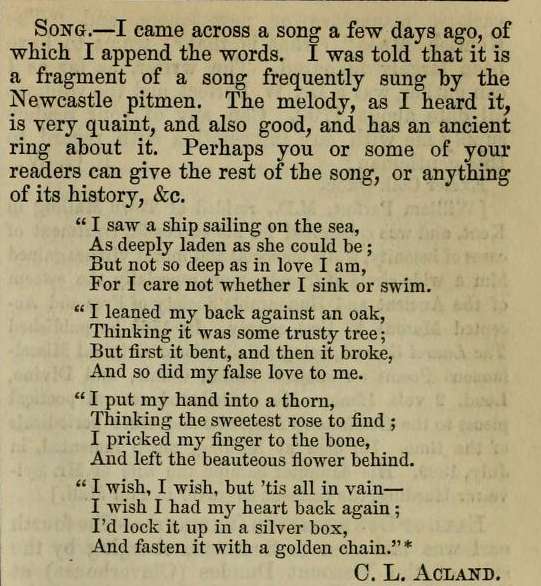
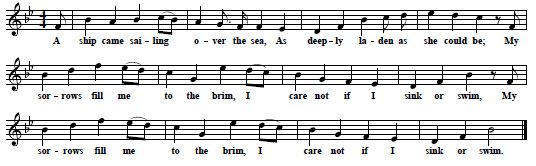
A ship came sailing over the sea, It is clear to see that the Rev. Baring-Gould has edited his text. For example he – who was a gifted songwriter himself - introduced a consistent rhyme scheme: in all verses it is aabb. Thankfully his manuscripts are now easily available (see Martin Graebe's Guide to the Baring-Gould Manuscripts on his site Songs of the West). Most important in case of "Deep In Love" is the chapter LXXXVI in the first volume of the so-called Personal Copy Manuscript. There we can find the variants of this song he had collected as well as important additional information. A pdf-file with a transcription of this particular chapter can be found on Martin Graebe's site. Images of the original pages are available in the Full English Digital Archive (SBG/1/1/404-415). The first thing to note is that Baring-Gould really had done his homework. In the manuscript he quotes the related verses from "Oh Waly, Waly", "Picking Lilies", "The Distressed Virgin" and Johnson's "Down In Yon Meadow" and also refers to a broadside of "The Unfortunate Swain". But it is also obvious why he felt it necessary to edit the song. In fact the texts of three variants he had collected were all fragments of dubious quality and it would have been impossible to use them for a songbook intended for a non-scholarly audience. One version (text A) was sent to him by Miss Octavia L. Hoare, a correspondent from Cornwall. She had "heard it sung by an old Cornish parson, Mr. Walker of S. Enoder, who had picked it up from an old fellow in his parish". It consists of the same four verses as the version from Newcastle published in Notes And Queries in 1867, that means including the additional one starting with "I wish, I wish in vain [...]". I really wonder why this particular variant was only found in the Southwest and the Northeast of England and nowhere in between. But maybe Mr. Walker or Miss Hoare were also readers of Notes & Queries: A ship came sailing o'er the sea, The second one (text F) with only three badly remembered verses was recorded from William Nichols,Whitchurch, Devon, whose "grandmother sang it to him in 1825": In the meadow t’ other day Where love is planted there it grows Ten thousand ladies in the room The third fragment (text B) was taken down from "Mary Sacherley [i. e. Sally Satterley], aged 75 [...] daughter of an old singing moor man", a "famous singer on Dartmoor". But the text in the Personal Copy and also in the Fair Copy Manuscript (see SBG/3/1/422 ) had already been repaired by Baring-Gould. In the Working Notebook 3 (SBG/2/2/244, both available at The Full English) we can find what looks like the original version of this variant: I shall be bound and she be free, In fact it was not much he had at hand but he managed to put together a more or less coherent song with a consistent rhyme scheme. The tune used in his book was the one sent to him by Miss Hoare together with the text quoted above. Baring-Gould left it more or less intact (see also Rough Copy, Vol. 2, SBG/3/5/8A, at The Full English). But he also noted that both Mary Sacherly and William Nichols sang the same tune, but the former "with twists" while the latter's was "imperfect". Interestingly in the Personal Copy Manuscript a second tune can be found. But that one is completely different from Miss Hoare's. It was sent to him – apparently without a text - by "Lady Lethbridge as sung by her old nurse":
After the turn of the century the collectors still found more relics of the song. Some time between 1907 and 1911 George Butterworth (see The Full English) recorded in Sussex a text with four verses that was clearly derived from that broadside (GB/4/59, at the Full English) although he obviously regarded it as a variant of "Waly, Waly": Down in those meadows fresh & gay, In 1909 George Gardiner collected a tune with one verse from one Thomas Bulbeck, also from Sussex (GG/1/21/1385, at The Full English):
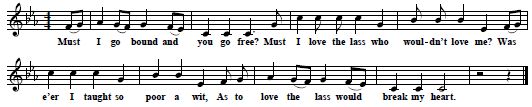
The same year Herbert Hughes published in the first volume of his Irish Country Songs (p. 68-9) a "fragment of an old song" from County Derry that is clearly a very mutilated relic of the "Unfortunate Swain". In this case even the "childish part" got lost:
Must I go bound and you go free, We have even one single version from North America, another fragment of two verses that were recorded by Cecil Sharp from the singing of Jane Gentry in 1916 in North Carolina (Sharp Ms.: CJS2/9/2544 (text), CJS2/10/3456 (tune) at The Full English Digital Archive; see also Smith 1998, p. 157). The melody, by the way, is very different different from all the others we have come across so far: As I walked out one morning in May, In all these more or less fragmentary versions one can find a combination of verses that is - to my knowledge - only known from "The Unfortunate Swain" and its off-springs. Most of the informants couldn't remember too much of the original text. Apparently these relics of the old broadside ballad were no longer part of the active singing repertoire. Instead it was a song heard and learned many decades ago and then only recalled for the collectors when they asked for "old songs". But at least at some point it must have been known all over the British Isles. Otherwise all these fragments wouldn't have been found in so many different places. Apparently the song was mainly disseminated with the help of broadsides and other printed matter. All the collected texts are very close to the commercially published versions. Some of the tunes presented here are clearly related to the one published by Johnson in the Scots Musical Museum, not only Hepple's but also the first strain of Christie's version, the one sent to Baring-Gould by Lady Lethbridge and the one collected by Gardiner in Sussex. There is good reason to assume that a melody of this kind had already been in use for "The Unfortunate Swain" in the 18th century. Perhaps this was the "original" tune of the song. The others - including the two collected by Sharp - are not related to this group and they are also very different from each other. I am inclined to think that they were all applied to the song at a later point, perhaps by singers who had learned the text from a broadside or chapbook. Now there is one question left. What about the tune used by Mrs. Cox? Unfortunately it is not known where she had learned it and to my knowledge this particular melody hasn't been found elsewhere. It's in no way related to any of the others collected with this song. J. W. Allen (p. 163 & 171) notes that "a similar tune to this occurs in a version of 'Lord Thomas and Fair Ellinor" and again in a version of [...] 'Young Hunting', from the Appalachians", all collected by Cecil Sharp in 1916. In fact the melodies of versions A and C - and D should also be mentioned - of "Lord Thomas" (Sharp 1917, No.16, pp. 55, 58, 59) are partly related to the one sung by Mrs. Cox. But it's only the musical phrase in first two bars that is similar while the rest of the song is very different:
The same can be said about the variant of "Young Hunting" he refers to (Karpeles, Appalachians, No. 18 H, p. 110):
Allen (p. 164) also claims that the tune of a variant called "Deep In Love" - collected by H. E. D. Hammond in Dorset in 1905 (see Broadwood et al. 1923, pp. 69-70 and HAM/2/5/15 at The Full English) - "is very similar to that printed and published by Sharp [...] we may say that, this tune, in its various forms, is the one proper to the song 'Down In The Meadows'" (i. e. "The Unfortunate Swain"). I must admit I can't hear much similarities. At best these two melodies are only very loosely related to each other. Nor do I think that it qualifies in any way as an offspring of the original tune of the broadside song. As noted above Johnson's would be a much more likely candidate for this honor.
Another related tune was found by singer Sam Hinton. On his LP "The Wandering Folk Song" (1966, Folkways FW 02401, see the liner notes, p. 2) he did not only sing a version of "The Water Is Wide" but also a hymn called "The Happy Land" with words by Isaac Watts. He had taken this text together with a "tune, which sounds to me so much like 'The Water Is Wide'" from Joshua Leavitt's The Christian Lyre. This book was first published in New York in 1830 (here from the 3rd ed. 1831, p. 128):
On this LP Hinton also sings an "anti-liquor song" called "Intemperance" - found in "The Western Minstrel, a songster printed about 1850" (liner notes, p.3) - that has the same tune. But this particular melody is very obviously not identical to the one used by Mrs. Cox. They only share some melodic motives. In the end this leaves two possibilities. Either Mrs. Cox has created the melody all by herself: the similarities to the songs mentioned above may be purely coincidental or she simply used the same musical motif as the starting-point. Or else what she sang for Sharp is also derived from the undocumented English predecessor of these American tunes, perhaps a hymn learned in school or in the church or a popular song from the early 18th century.. But that's of course speculation and at the moment this question can't be answered. Nonetheless I think she should be given appropriate credit as the originator of this particular tune.
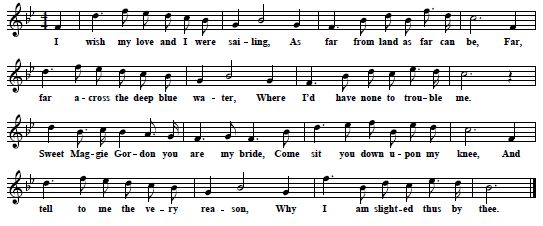
V.The two fragments Sharp secured from Elizabeth Mogg are relics of another broadside ballad called "I'm Often Drunk And Seldom Sober". That one was published in two versions. The first with nine verses and a chorus can be found for example on a song-sheet printed by John Pitts in London (Johnson Ballads 868, at BBO): Many cold winters nights I've travell'd, This is a song of somehow dubious quality, in fact it looks more like a random selection of verses without much inner coherence. Most interesting are the two stanzas that were apparently borrowed from "Oh Waly, Waly": the third with "I lean'd my back against an oak" and the sixth with "love is handsome and love is pretty". The reference to Dublin in the fifth verse suggests a connection to Ireland. But the anonymous author of this piece was not necessarily one of the great poets of his era. Much of the text sounds very clumsy and in the fourth as well as in the last verse there aren't even any rhymes. When was this song first published? Pitts' address on this broadside is "6, Great St. Andrew Street, 7 Dials". There he was active between 1819 and 1844 (see The British Book Trade Index) but that doesn't help much. Other editions of this version help to narrow the date. One was published by Pitts' great rival James Catnach, 2 Monmouth Court, Seven Dials (Madden Ballads 5-3183) and he was active between 1813 and 1838. All his song-sheets at the allegro Catalogue are dated that way. Robert Walker from Norwich "near the Duke's Palace" also threw a copy of the song on the market (Harding B 25(894), at BBO). According to Brown (Glimpses 32, at mustrad) he worked at this address "from c. 1818 up until the late 1820s". Another broadside with this song was published by "Evans Printer, Long-lane, London" (Harding B 17(136b)). In the allegro Catalogue this edition is dated as from "between 1780 and 1812". But that is misleading. Brown (Glimpses 32, at mustrad) notes that "there was a whole Evans clan operating in London" and they worked at Long Lane "between 1791 and 1828". Quite a lot of different imprints were used for the Evans family's publications but this particular one can be found on many song-sheets and some of them are even exactly dateable. For example there was one with the songs "Rose of Albion" and "God Save The Queen" (Harding B 11(3324)). Both were about Queen Caroline. In 1820 George IV ascended the throne and his wife Caroline of Brunswick-Wolfenbüttel returned to Britain from Italy where she had spent the last six years. The new queen had been separated from her husband for a long time but she was still very popular in England and was received with great entusiasm. These two songs must have been written at the time of her return. Evans also published other songs about Caroline with the same imprint, for example "Caroline's Return", "Remember your Queen ,&c." and "Appeal of Innocence" (Firth c.16(28)). But it can also be found on some earlier publications. "Prince Cobourg's Lamentation For The Loss Of Princess Charlotte" (Harding B 16(274a)) was written after the death of the popular princess in 1817. "Boney's Defeat at Waterloo. A new song" (Curzon b.33(193)) and "Elwina Of Waterloo" (Firth c.14(39)) were of course published after the famous battle in June 1815. A chapbook called "Nelson's Wreath, Or British Glory" with "A new song on Lord Nelson's victory at Copenhagen" (Curzon b.24(99), all at BBO) is dated as from "1801- 1805". But generally it seems to me that this imprint was mostly used during the ‘10s and early '20s. I am inclined to think that "I'm Often Drunk" was first published around 1819 or 1820. John Pitts had been in this business since 1802 and until 1818/19 he had his headquarters at 14, Great St. Andrew Street. One may assume that he would have brought out the song already while working at this address if it had been available earlier. There are some more extant copies of this song but they were published a little bit later. Joseph Phair (Madden Ballads 7-4995) was busy in London between 1827 and 1853 (see The British Book Trade Index). Thomas Birt (Harding B 11(1730) & Madden Ballads 6-4172), also from London, started his business around 1824 (see The British Book Trade Index) and in the allegro Catalogue his song-sheet is dated as from "between 1828 and 1829". Another copy was brought out by "Mate, C., No. 9 Market Place, Dover" (Madden Ballads 11-7451) . According to the Book Trade Index there were two printers with that name at that address in Dover. One published between 1807 and 1825 and the other one between 1832 and 1839. James Catnach still listed this song in a catalogue published in 1832 (p. 4). John Harkness in Preston started his business only in 1840 but he also printed a copy of this song (Madden Ballads 9-6415). A second version of "I'm Often Drunk" is little bit shorter. Two verses were dropped, the first of the longer version ("Many cold winters nights I've travell'd [...]") and one of the two borrowed from "Oh Waly, Waly" ("I leane'd my backagainst the wall [...]". The song now starts with a slightly edited variant of what was originally the second verse. For reasons unknown to me the "false lover" in the stanza starting with "I wish I was in Dublin city" was replaced by "lawyers". Here is the text published by W. Armstrong in Liverpool between 1820 and 1824 (Harding B 28(63), at BBO): The sea is wide and I can't get over, The editor of this particular text even tried to repair the last verse and introduced an appropriate rhyme. But this variation can't be found in any other extant copy of the shorter version of the song. Four more prints have survived. In the allegro Catalogue we can find an undated sheet without imprint (Harding B 25(893)). This one is also listed in the English Short Title Catalogue (ESTC T197384) with "1790?" as the possible date of publication. That seems to me highly unlikely because that would have been nearly 30 years before the longer version and more than three decades before other prints of the shorter text. Another edition was brought out by William Wright from Birmingham (Madden Ballads 11-7422). The address given on the song-sheet is "No.113, Moor-st" where he worked between 1822 and 1826 (see Palmer, Birmingham Ballad Printers 4, at mustrad). Later the text was also published by Ring Hurd in Shaftesbury (Madden Ballads 11-7809, possibly 1830, see British Book Trade Index) and by Liptrot in St. Helen's (Harding B 11(1731), at BBO). St. Helens is about 25 miles from Manchester and according to the Book Trade Index one Daniel Liptrot was busy there as a printer in 1841. All available evidence seems to suggest that "I'm Often Drunk, And Seldom Sober" was popular from the early '20s to the '40s. It was known not only in London but also published in other parts of England. Mrs. Mogg must have heard the song in her youth and in 1904 she recalled a fragment of the shorter version: two more or less complete verses as well as two half verses that she merged to one. In her second attempt she managed to remember one more stanza and the refrain. Interestingly no other collector has noted variants of this song from his informants. To my knowledge Sharp was the only one. It is well known that he was no friend of these kind of broadside ballads and I assume he usually wouldn't have looked twice at such a song. But in this case Mrs. Mogg's second verse - "Love is handsome [...]" must have caught his attention because he recognized it as a variant form of the of the second verse of Ramsay's "O Waly, Waly, Gin Love Be Bonny" and "its occurence [...] probably led Sharp to believe that the song was really 'O Waly Waly' badly remembered" (Allen, p. 165). This may be the reason that he also used her first verse ("The water is wide..."). It fit well into the song he was constructing and maybe he thought it was an otherwise lost part of an older oral variant of "Oh Waly, Waly". But in fact it had never belonged to earlier versions of that song. The line "the water is wide" as used since Sharp definitely derives from Mrs. Mogg, it was her own variation of "the sea is wide" from the second edition of "I'm Often Drunk". To my knowledge a verse like this hasn't been part of any song written before that broadside ballad. Variants of this verse were occasionally used in other songs but none of them predates the broadsides with "I'm Often Drunk" that was apparently first printed around 1820. Already in the 1820s and early 1830s a song called "Peggy Gordon" was published on American song-sheets: in New York and in Boston (available at the libraries of Brown University, RI and the New York Historical Society, here quoted from Mudcat Discussion Board, posted by user Taconicus on 23.12.2010): Sweet Peggy Gordon, you are my darling, Here we find three verses known from the longer version of "I'm Often Drunk" including the one starting with "the seas are deep, and I cannot wade them [...]". It seems this song was very popular. It was later also published in Everybody's Songster (1859, Roud ID S187124) and the Old Armchair Songster (1860, Roud ID S302091). I haven't been able to check these publications and can't say if it's exactly the same text. But they also start with the line "Sweet Peggy Gordon, you are my darling". In 1880 New York publisher Pauline Lieder brought out a song called "Sweet Maggie Gordon". This was in fact an abbreviated version of the old "Peggy Gordon" with some minor changes but the three verses can also be traced back to the first edition of the British broadside. On the sheet music (available at Music for the Nation: American Sheet Music, Library of Congress) composer and songwriter Ned Straight is only credited as the arranger so the tune may be older and perhaps even the one used for the original "Peggy Gordon":
I wish my love and I were sailing, A version from West Virginia with more or less the same words was collected by J. H. Cox in 1918 ("Maggie Goddon", Cox, No. 142, p. 424, "learned forty years ago"). Variants called "Peggy Gordon" with more and different verses were recorded in Canada since 1943 (Roud # 2280; see the versions on Alan Mills and Jean Carignan, Songs, Fiddle Tunes and a Folk-Tale from Canada, Folkways FW 03532, 1961 and Maritime Folk Songs: from the Collection of Helen Creighton, Folkways FW 04307). In another song from West Virginia called "Youth And Folly" we find variant forms of three verses known from "Peggy Gordon". Another one - "O love is warming [...]" - is clearly derived from "I'm Often Drunk" (collected in 1916, Cox, No. 141, p. 422). The informant had "learned it from his father": Youth and folly make youngsters marry, Parts of "I'm Often Drunk" can also be found in the Irish song "The Young Sick Lover". According to John Moulden (Mudcat Discussion Board, 31.01.2000) this strange bilingual text was published by Haly in Cork "c 1840". A reprint by John Troy from around 1860 can be found in the J. D. White Collection at the Trinity College, Dublin (Cashel Ballads, Vol. 2, EPB OLS X-1-531, image 49; see also the catalogue record): [...] [...] Interestingly here the "marble stones" are also "black as ink". The same phrase can be found in the American "Peggy Gordon". It is not unreasonable to assume that these two songs have a common ancestor, perhaps an undocumented Irish version - or predecessor - of "I'm Often Drunk". Another offspring of "I'm Often Drunk" was published in 1900 in the Journal of the Folk-Song Society. It was contributed by one "Mr. H. C. Mercer, of Philadelphia, and he describes it as a 'Down East' coast song from the neighborhood of Portland, Maine" (Fuller Maitland 1900, p. 29 & 45). The same tune with only two verses can also be found in Sam Henry's Songs of the People (Huntington & Hermann 1990, p. 383). But no source is given there and I am inclined to think that he had simply taken it from the Journal:
O the ripest of apples, they must soon grow rotten, This is a fragmentary version of the earlier and longer variant of "I'm Often Drunk": it still uses the phrase "I cannot wade them" instead of "can't get over". The first verse about "the ripest of apples" was most likely developed from or inspired by the verse starting with "If love is handsome [...]" in "I'm Often Drunk", the one borrowed from "Oh Waly, Waly". Both are about love growing cold with the time and offer a similar message although the new variant sounds a little more drastic. Interestingly this particular stanza has occasionally infiltrated other songs: one called "Twenty, Eighteen" from Norfolk that was published in 1893 in Lucy Broadwood's and J. A. Fuller Maitland's English County Songs (pp. 90-1); one from North Carolina (Brown II, No. 165, p. 428) and a piece called "Spanish Lady" from West Virginia (Cox, No.158, p. 466). None of them is in any way related to this particular fragment or to "I'm Often Drunk". But at least the wide dissemination of this verse allows the conclusion that it was coined already in England. Folklorists in the USA have found a lot of variants of a song usually called "Fair And Tender Ladies" or "Little Sparrow" (Roud # 451, see f. ex. Campbell & Sharp 1917, No. 65, p. 220-222 and M. E. Henry 1938, No. 79, p. 257-260). This is a very flexible and unstable mixture of verses from many different sources and there are no two versions alike. Some of them include variant forms of the verse originally starting with "Love is handsome […]" , for example this text from North Carolina from the "first decade of the present century" (Brown 1952, Vol. 3, No. 254B, p. 291): Come all ye fair and tender ladies, It would be worth discussing if the verse about the "little sparrow" is in some way related to the one starting with "the seas are deep" from "I'm Often Drunk". Both share the second line, here in the original text: Neither have I got wings to fly This is very similar to "No wings, and cannot fly so high" in Brown's text quoted above, to "Nor have I any wings to fly" (M. H. Henry, No. 179B, p. 258) or to "Got no wings, nor I can't fly" (Sharp, No. 56 B, p. 221). Maybe this line was the starting-point for the development of the key verses of "Little Sparrow". Other variants including these two verses were collected for example by John H. Cox (No. 149, pp. 419/20). Interestingly his version B contains the phrase "marble stones" that is of course known from the broadside of "I'm Often Drunk". But here there are also "black as ink" as in "Peggy Gordon" and "The Young Sick Lover": [...] That expression can also be found in his version A, but without the "marble stones". Instead the "ivy rock is black as ink". The occurrence of this phrase also supports the assumption that there could have been an Irish version of "I'm Often Drunk" that migrated to North America at an unknown date. There it apparently became not only the precursor of "Peggy Gordon" but also one of the sources for the songs of the type "Fair And Tender Ladies/Little Sparrow". This would be the most logical explanation for the dissemination of this verses and phrases.
VI.It seems that especially the verses associated with "Oh Waly, Waly" and related songs have been very popular among the producers of broadsides. They regularly recycled verses for "new" texts. Two pieces published circa 1780 demonstrate this technique. "Forsaken Lover. Tune Farewel You Flower Of False Deceit" (ca. 1780, ESTC T040047, available at ECCO) shares three verses with "The Unfortunate Swain" and and includes variant forms of two more known from "Oh Waly, Waly": I run my finger into a bush, The writer of "The Effects of Love. A new Song" (London?, ca. 1780, ESTC T032452, available at ECCO) used the same two verses and edited them in a different way to make them fit into his "new" song. But these two and one more line are also related to "Arthur's Seat Shall Be My Bed" (ca. 1701, available at NLS: The Word On The Street), another one from this family: O! Love is hot, and love is cold, Interestingly the first verse here is clearly a variant form of the third in "Oh Waly, Waly" ("O waly, waly, but love be bonnie […]") but this particular version did not survive. Instead the variant later used in "I'm Often Drunk" ("Love is handsome, love is pretty […]") prevailed and started a life on its own, both as a floating verse and as the lead stanza for new songs. For example it became a refrain in a "simple ditty with a pleasant air" called "Love It Is Easing" that was noted by British collector Alfred Williams in Wiltshire County (MS collection No Wt 496, undated, before 1914; also available at the Full English Digital Archive: AW/4/193): When I was young and well beloved, In Scotland Greig and Duncan have noted a fragment with only one verse that could be a relic of this song (Greig-Duncan VI, No.1166, p. 252):
Other more complete versions were collected by H. E. D. Hammond in Somerset in 1905 ("Love It Is Pleasing", HAM/2/1/23) and by Charles Gardiner in Hampshire in 1907 ("Love Is Teasing", GG/1/16/1002, both at the Full English). Interestingly most of the rest of the text is derived from another old broadside called "The Wheels of Fortune" that includes a variant form of one verse known from Ramsay's "Oh Waly, Waly" (Mu23-y1:104 and Mu23-y1:105 at Glasgow Broadside Ballads and Firth c.18(132) in the allegro Catalogue of Ballads, all undated, see also the version in Christie, Vol. 1, p. 260): When I was young I was much beloved On the British broadside sheet this song is combined with "The Green Willow" that includes another variant form of this verse: You false-hearted young men you know you have deceived me, Some time in the 1940s Jean Ritchie learned a little song from an "Irish girl" (Ritchie, p. 24): Oh, love is a teasin' and love is pleasin' She regarded this song as an "enchanting version of 'Waly, Waly'" but in fact it looks more like a fragment of "Love It Is Easin'/Pleasin'/Teasin'" as collected in Britain by Williams, Hammond and Gardiner. Variants of the second verse - "Come all ye fair maids, now take a warnin [...]'" - are of course also known from the American song "Fair And Tender Ladies". In 1960 Alan Lomax published a slightly different version called "Love Is Pleasin'" in his Folk Songs of North America (No. 70, p. 136): Oh, love is a pleasin' and love is teasin' The new third verse - I don't know if it was inserted by Lomax himself or by Jean Ritchie - is of course well-known from "Waly, Waly" but in fact much older. At least it had been used in the broadside ballad "The Seamans leave taken of his sweetest Margery" (see Pepys 4.158, EBBA) long before "Waly, Waly" was published for the very first time: But had I wist before I kiss't A different version of this verse is part of at least two variants of "The Unfortunate Swain" from oral tradition that I have already mentioned: one from Cornwall that can be found in Baring-Gould’s manuscripts and the other a fragment from Newcastle (Notes And Queries, 3rd Ser., Vol. 11, 1867, p. 441): I wish, I wish, but 'tis all in vain - It was also included in some variants of "Fair And Tender Ladies"/"Little Sparrow". Both Ritchie (p. 18) and Lomax (No. 99, p. 205) have published a version in their collections as have for example also Cecil Sharp (No. 65 B, p. 221), Mellinger E. Henry (pp. 257-260, versions A, C, D) and Frank C. Brown (Vol. 3, No. 254, pp. 290-293, version A & C). Here's Brown's version A "as sung by a woman in 1907": Come all ye fairer tender ladies, Of course all these verses are interchangeable, they all fit well into this kind of laments of lost love. I presume Lomax - like Sharp with his composite text - tried to "reassemble" a "Folk"-version of "Waly, Waly". But the addition of this verse makes sense for another reason because it was also part of the broadside song "Wheel Of Fortune" that had been the major source for the British "Love It Is Easin'/Pleasin'/Teasin'". I'm not sure how popular this broadside was, I only know of one English and two Scottish prints. But at least one American variant of "Little Sparrow/Fair And Tender Ladies" quotes extensively from this song (M. H. Henry, p. 261). This is another case where the broadsides served as a conduit for the survival of an old verse. Lomax' "Love Is Pleasin'" is not so much a "Folk"-version of "Waly, Waly" but a fragment of the broadside song "The Wheel Of Fortune". Another ancient verse from the "The Unfortunate Swain" - later recycled by Sharp for the longer version of his "Waly, Waly" in One Hundred English Folk Songs, 1916, p. 90 - has also taken on a life of its own: Must I be bound that can go free? It had not been part of the original "Oh Waly, Waly, Gin Love Be Bonny". As already noted an early form of this particular verse can be found in another related older song, "Arthur's Seat Shall Be My Bed, or: Love in Despair" (available at NLS: The Word On The Street and in Child, p. 105). But the phrase "act such a childish part" seems to have been introduced by the "Unfortunate Swain". I know of no earlier occurrence. A variant form of this stanza was used for a broadside ballad called "The Complaining Lover - A New Song" (ca. 1795, Madden Ballads 2-1082, ESTC T198961): Must I be bound that can go free, In 1905 Folklore collector H. E. D. Hammond noted a song from Jacob Baker in Dorset (Broadwood et al. 1923, pp. 69-70 and HAM/2/5/15 at The Full English). Here we find a couple of verses from "The Complaining Lover" combined with five from "The Unfortunate Swain". But the new version of the first stanza had not survived, instead Mr. Baker used the one from the latter song: Must I be bound, or must I go free? This verse and especially the the expression "the childish part" showed considerable persistence. It was also adapted in North America for some other of songs. "The Man That Wouldn't Hoe Corn" in Louise Pound's American Ballads And Songs (1922, pp. 110/11, p. 249; a variant of this song called "The Lazy Man" without this particular verse is available in the Journal of American Folklore 29, 1916, pp. 181/2) - collected 1914 in Nebraska - shows a quasi-feminist approach: "I won't be bound, I will be free, In the same collection we can find a version of "My Blue-eyed Boy" from Nebraska (ca. 1905, p. 212) that also includes this verse. Frank Brown once noted that this song has "one of those Protean folk-lyrics whose identity is hard to fix because they shift from text to text, taking on new elements and dropping old ones from the general reservoir of the folk fancy" (Brown 1952, Vol. 3, p. 298). His own "Blue-Eyed Boy" as well a variant collected by Paul Brewster are very different from Pound's but have retained this particular verse (see for Brown 1952, dto.; Brewster 1940, p. 85, here as "I turn back to my childhood part" [sic!]). "Bring Me Back My Blue-Eyed Boy" in Carl Sandburg's American Songbag (1927, p. 324) looks more like a version of "The Butcher Boy" while "Brisk Young Lover" as sung by Jane Gentry in 1916 for Cecil Sharp (Smith, p. 175, the melody is also in Sharp 1917, No. 101B, p. 287) is in fact "The Butcher Boy" with a mutilated variant of this verse - without the "childish part" - added at the end of the song. Sam Henry's Songs Of The People (Huntington 1990, p. 386) includes a complete song from 1928 called "Must I Go Bound" that opens with this verse but none of the others are in any way related to those known from the old broadside. In this case it has become the starting-point for a new song and has lost all connections to the original ballad. In 1954 American American Folk singer Susan Reed recorded a short song called "Must I Go Bound" for her 10-inch LP Old Airs From Ireland, Scotland and England (Elektra EKL 26). Must I go bound and you go free, In fact this is a edited version of the two-verse fragment of "The Unfortunate Swain" collected by Herbert Hughes and published as "Must I Go Bound?" in his Irish Country Songs (Vol. 1, 1909, pp. 68-9). In Hughes' text the "childish part" was missing. Instead there was a rather strange line: "Was e'er I taught so poor a wit". Here it was replaced with another line of somehow dubious quality. In 1965 Buffy St. Marie recorded a much longer version of "Must I Go Bound" (at the moment available at YouTube) for her LP Many A Mile: Must I go bound and you so free This version has been supplemented with some verses from Pete Seeger's "The Water Is Wide". That means that the fragment collected by Mr. Hughes in Ireland was completed with some of the missing parts from just the right song. Both are derived from "The Unfortunate Swain" and both share one verse of the original broadside text as Seeger's edited version of Sharp's "Waly, Waly" still includes these lines: I put my hand into some soft bush, "Must I Go Bound" is in fact "The Water Is Wide" with a different melody and a different lead verse: the one starting with "Must I go bound [...]". Both songs are modern variants of the same ancient broadside ballad with a little input from another old song-sheet. They have reached us on different transmission routes, but their trip was very similar: first was the broadside with scattered verses from older songs, then the "Folk" that stored these texts in their memory for a couple of decades, then the Folklore collectors who saved these verses from oblivion by writing them down and publishing their findings in books and then at last the Folk Revival singers who used them for new "old" songs.
VII.It seems that the original "Oh Waly, Waly" was literally broken into pieces by the writers of all those broadsides. They systematically plundered Ramsay's text as well as those of other related songs. These verses were then disseminated by songs like "The Unfortunate Swain", "I'm Often Drunk", "The Wheel Of Fortune", "Forsaken Lover", "The Effects Of Love" and therefore the people kept them in their memory. When the Folklorists started collecting they encountered these relics just around every corner. But it seems that Ramsay's text itself had very little or even no influence on oral tradition even though it had been printed and reprinted so often. Apparently only the broadsides served as the conduit for these verses' transmission. The collectors found them among the "Folk" either in fragmentary versions of this particular broadside text or as floating verses in all kinds of different songs and then secured their subsequent survival. They were published in academic collections or in songbooks for popular consumption and performed, published and recorded by Folk revivalists. In case of "The Water Is Wide" the route of transmission is easy to follow. At first there were the texts of "Oh Waly, Waly, Gin Love Be Bonny" as published by Allan Ramsay and William Thomson in the 1720s as well as some other songs printed on broadsides in the 17th century like "The Seaman's Leave...", "Arthur's Seat Shall Be My Bed" and Martin Parker's "Distressed Virgin". Some verses from these texts were then borrowed and included in "new" songs like "The Unfortunate Swain" and "I'm Often Drunk And Seldom Sober" that were published on popular broadside sheets during the second half of the 18th century and in the early 19th century. Fragments of these songs were recalled by Mrs. Cox, Mr. Thomas and Mrs. Mogg during the years 1904 and 1906 for song collector Cecil Sharp. He then compiled his own new "old" song from those fragments and published it as "Oh Waly, Waly" in 1906 in Folk Songs From Somerset and in 1916 in One Hundred Folk Songs Cecil Sharp's "Oh Waly, Waly" is the starting-point for the development of the modern "The Water Is Wide". It was in effect a new song constructed from relics of two popular songs. He tried to put together a "Folk"-version of "Oh Waly, Waly" but the only connection to that old Scottish ballad was that the creators of the two broadside texts themselves had cribbed one respectively two verses from that song. Interestingly Sharp's methods were strikingly similar to those of the writers of "The Unfortunate Swain" and other broadsides. They had compiled their songs from verses borrowed from different sources and claimed it was "new" while Sharp did exactly the same thing but preferred to regard his work as an "old" song. In fact both were only half right. In some way he had unwittingly followed the rules of the genre. A modern Folklorist will not regard his song as "authentic" but a professional author of broadside songs from the 18th or 19th century and also the singing "Folk" surely would not have been bothered by his methods. For some reason Sharp's song had a slow start. At first only classical composers took interest and brought out arrangements for solo singers or choirs, for example Herbert William Pierce in 1931, Robert Chignell in 1935 or Reginald Redman in 1943:
The best known was of course Benjamin Britten's version that he first published in 1947 in his Folk Song Arrangements, Vol. 3: British Isles (see Peter Pears with Britten at the piano at YouTube). His arrangement is still regularly performed by classical singers. The first "Folk"-recording was by singer and dulcimer player Andrew Rowan Summers from Virginia who included "Oh, Waly, Waly" in 1954 for his LP The Faulse Lady (Folkways FW02044). He sang the version with eight verses from Sharp's One Hundred English Folk Songs (1916, p. 90) although the source is not credited in the liner notes. Instead for some reason it is claimed that this "famous old song […] is widely known and sung throughout all English-speaking countries". I really wonder where he got that information. But I assume that he simply wanted to obscure the fact that he had learned it from a book. In fact this song only became "famous" after Pete Seeger had recorded his version in 1958. He deleted one verse, played it in common time instead of the original triple rhythm and was the first one to call it "The Water Is Wide". As already noted he forgot to give credit to Sharp and his informants in the liner notes to his record but had to acknowledge the original copyright by Novello & Co. when the piece was published by Oak Publications in 1960 in the songbook American Favorite Ballads. Tunes and Songs as Sung by Pete Seeger (p. 4 & 77):
The water is wide, I cannot get over Roger McGuinn (quoted from his Folk Den) saw "Pete Seeger in concert at Orchestra Hall in Chicago many times in my teen years. His 12-string guitar was always tuned down so that the bass notes were big and round, filling the hall as would a string quartet. His voice was clear, full of emotion and youthful exuberance. That was the first time I heard The Water Is Wide". Guy Carawan recorded it also in 1958 for Folkways (FW03544) and in his liner notes he wrote that Seeger had taught it to him while "driving along in a car in upstate New York". But he also reported that he had heard the song "later" in London as sung by Shirley Collins. So it seems it was already known in Folk Revival circles before it was recorded by Pete Seeger. Other early recordings were by Leon Bibb on Sings Love Songs (1960, Vanguard VRS 9073, see the discography at wirz.de) and Carolyn Hester on her second LP in 1961 (Tradition TLP 1043). Ms. Hester also sang Seeger's version although this was deliberately obscured in the liner notes written by Robert Shelton (as Stacey Wiliams, his pseudonym for these kinds of jobs). At least Sharp got some credit although he of course had never collected the song in the USA: "During one of her many visits to the Archive of American Folk Song at the Library of Congress the singer came upon "The Water is Wide", a song collected in America by Cecil J. Sharp. Polished poetry in the text seems at times to be the work of a highly gifted poet, but actually has evolved through the folk process into one of the most beautiful, remorseful lyric statements in the body of Anglo-American folk song". The song can also be found on Pernell Roberts' Come All Ye Fair And Tender Ladies (1963, see allmusic.com). Joan Baez included it in 1964 in her Songbook, but without any credit to Seeger or Sharp. She also performed "The Water Is Wide" in her concerts although to my knowledge she didn't record the song for any of her early LPs. A live recording from the early 60s is available on Very Early Joan (see JoanBaez.com) released in 1982. Here the song is credited as "traditional, arr. by J. Baez". The melody of Bob Dylan's "Lay Down Your Weary Tune" sounds as if it is closely related to the one used for "The Water Is Wide". Dylan later reported that he had "heard a Scottish ballad on an old 78 record that I was trying to really capture the feeling of, that was haunting me [...] It was just a melody (liner notes to Biograph, 1985). Unfortunately it's not known which record he had listened to. Sam Hinton's version on "The Wandering Folk Song" (1966, Folkways FW 02401, see the liner notes, p. 2) is one of the few that was taken directly from Cecil Sharp. He refers to his One Hundred Folk Songs and in fact he uses six of the eight verses of the version published in that book, although most of them in a slightly edited form. But this was an exception to the rule and it seems that nearly everybody at that time learned the song directly or indirectly from Pete Seeger, either from live performances, from him personally, from the recording, or from any of the printed versions. Today The Water Is Wide" is firmly established as an "old Folk song". Seeger's version has become a standard. But nowadays usually only four verses are sung: one ("I put my hand into some soft bush […]") got lost sometime during the '60s. And now we have arrived again at the text I have quoted in the very first chapter: The water is wide and I can't cross over, This reduced version looks in fact very close to the original "Oh Waly, Waly": variant forms of two of these four verses – the third and the fourth - had already been part of that old Scottish ballad when it was first published by Thomson and Ramsay in 1726. Even though "The Water is Wide" as a song is not that old in fact the verses themselves are of great antiquity and it's fascinating to see that they have survived for so long. The earliest variant of the first one was printed on a broadside as part of the song "I'm Often Drunk And Seldom Sober" around 1820, the second ("There is a ship...") sometime between 1660 and 1684 on another broadside called "The Seamans leave taken of his sweetest Margery", the third about the "trusty tree" can be found in both variants of "Oh Waly, Waly" (1726) and the earliest form of the last verse is known from an old manuscript from the 1620s. The oldest has been in use for nearly 400 years and even the youngest is known for nearly two centuries. They have survived for so long because of a complex process involving both written transmission and oral tradition. But it's also interesting to see how these verses have changed over the centuries. The earliest version of the last verse of looks a little bit different from the one used for "The Water Is Wide": Hey trollie lollie, love is jolly According to Robert Chambers (1829, p. 134) "troly, loly" was common as a "burden [...] of songs [...] during the sixteenth and seventeenth centuries". The variant in Ramsay's "Oh Waly, Waly, Gin Love Be Bonny" from the 1720s is much more similar to the verse as we know it today: O waly, waly, but love be bonnie, For the broadside text of "I'm Often Drunk And Seldom Sober" - published around 1820 - the words were modernized and the anachronisms deleted: If love is handsome, and love is pretty, When Mrs. Mogg from Somerset recalled this verse in 1904 for Cecil Sharp is was nearly identical to the one on the broadside. She only replaced "while it's new" with "when it is true": Love is handsome, love is pretty, The version Sharp published in his Folk Songs From Somerset in 1906 shows some interesting variations and is more similar to Ramsay's verse: "new" is reinstated and "old/cold" replaces "older/colder". But he also added something new by changing the last word of the first line from "pretty" to "fine" and the start of the second line from "love is charming" to "love's a jewel": O, love is handsome and love is fine, In Pete Seeger's version (1958) the second line looks a little bit different - "Gay as a jewel" instead of "love's a jewel" - and the traditional "morning dew" is changed to "summer dew". But there is also one more anachronism directly taken from Ramsay's "Oh Waly, Waly": "waxes" replaces "groweth". In fact every new edit makes this line look older and more like the one in "Waly, Waly": "grows older" in the texts from the broadside and from Mrs. Mogg was first changed by Sharp to "groweth cold" and then in this variant to "waxes cold" which is just like the original: Oh, love is handsome and love is fine, But in most of the versions used today the "morning" has returned and these days the second half of this verse looks surprisingly similar to the corresponding lines in "Oh Waly, Waly": every editor since Sharp has added one more element of the original text. Oh love is gentle and love is kind, The first verse of "The Water Is Wide" also shows an interesting development. In the longer version of "I'm Often Drunk" it looks this way: The seas are deep and I cannot wade them In the later edition with the abbreviated text "deep" was changed to "wide" and "cannot wade them" to "can't get over": The sea is wide and I can't get over Mrs. Mogg in 1904 was the first to use the phrase "the water is wide". That's a nice alliteration and it sounds much better than the original lines. Of course we don't know if she made it up herself or if she learned it that way from someone else: The water is wide and I can't get over In 1906 Cecil Sharp decided to retain the first two lines sung to him by his informant. But it seems he didn't like the second half of this verse and he simply replaced it with something he wrote himself. The water is wide l cannot get o'er That's the version of the first verse we know today. It was first made up by a writer of broadside ballads and then later edited both by an old lady from Somerset and an academic Folklorist. A "Folk song" is usually the result of a complicated process and the input of the professional ballad writers and the professional Folklorists is often much greater than what the real "Folk" has contributed. And sometimes an "old" song is not that old and sometimes a Folklorist had to produce a "Folk song" himself, especially if he wasn't satisfied with what he had found among the "Folk". But no matter who was involved in the creation of "The Water Is Wide": the song is still popular today and in the end that's what counts.
Musical Examples & Illustrations
Bibliography
Online Resources
Many thanks to Stewart Grant who has written about “The Water Is Wide” for my former website and who encouraged me find out a little more about this song! Comments: Please use my blog or send a mail to info[at]justanothertune.com
© Jürgen Kloss,
|
|
|
|
||||||||||||||||||||||||||||||||||||||||||||||||||||||||||||||||||||||||||||||||||||||||||||||







![5. "Hey troly, loly [...]",excerpt (verse 4) from Cantus, Three Voices, in: Cantus, songs and fancies, to three, four, or five parts, [...] as is taught by Thomas Davidson, in the Musick-School of Aberdene, Printed by John Forbes, Aberdeen 1666](../assets/images/Cantus-TrolyLoly-1666.jpg "5. \"Hey troly, loly [...]\",excerpt (verse 4) from Cantus, Three Voices, in: Cantus, songs and fancies, to three, four, or five parts, [...] as is taught by Thomas Davidson, in the Musick-School of Aberdene, Printed by John Forbes, Aberdeen 1666")
![7. "Waly,Waly", from William McGibbon, A Collection of Scots Tunes [...] With some Additions by Robert Bremner, London [1768], Book III, p.87](../assets/images/McGibbon-Bremner-ed-III-p87.jpg "7. \"Waly,Waly\", from William McGibbon, A Collection of Scots Tunes [...] With some Additions by Robert Bremner, London [1768], Book III, p.87")